COMMON WAYS TO HOLD TITLE
|
HOW YOU TAKE TITLE - ADVANTAGES AND LIMITATIONS:
Title to real property in California may be held by individuals, either in Sole
Ownership or in Co-Ownership. Co-Ownership of real property occurs when title is
held by two or more persons. There are several variations as to how title may be
held in each type of ownership. The following brief summaries reference seven of
the more common examples of Sole Ownership and Co-Ownership.
SOLE OWNERSHIP
- A Single Man/Woman: A man or woman who is not married.
Example: John Doe, a single man.
- An Unmarried Man/Woman: A man or woman, who having been married, is legally divorced.
Example: John Doe, an unmarried man.
- A Married Man/Woman, as His/Her Sole and Separate Property: When a married man or
woman wishes to acquire title as their sole and separate property, the spouse must consent and
relinquish all right, title and interest in the property by deed or other written agreement.
Example: John Doe, a married man, as his sole and separate property.
CO-OWNERSHIP
- Community Property: Property acquired by husband and wife, or either during marriage,
other than by gift, bequest, devise, descent or as the separate property of either is presumed
community property.
Example: John Doe and Mary Doe, husband and wife, as community property.
Example: John Doe and Mary Doe, husband and wife.
Example: John Doe, a married man.
- Joint Tenancy: Joint and equal interests in land owned by two or more individuals
created under a single instrument with right of survivorship.
Example: John Doe and Mary Doe, husband and wife, as joint tenants.
- Tenancy in Common: Under tenancy in common, the co-owners own undivided interests;
but unlike joint tenancy, these interests need not be equal in quantity and may arise at
different times. There is no right of survivorship; each tenant owns an interest, which
on his or her death vests in his or her heirs or devisee.
Example: John Doe, a single man, as to an undivided ¾ interest, and George Smith,
a single man as to an undivided 1/4th interest, as tenants in common.
- Trust: Title to real property in California may be held in trust. The trustee of
the trust holds title pursuant to the terms of the trust for the benefit of the
trustor/beneficiary.
The preceding summaries are a few of the more common ways to take title to real property
in California and are provided for informational purposes only.
There are significant tax and legal consequences on how you hold title. We strongly suggest
contacting an attorney and/or CPA for specific advice on how you should actually vest your title.
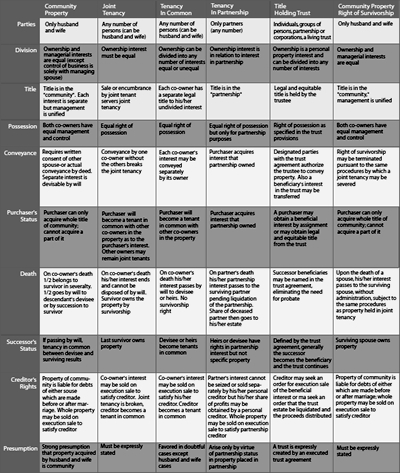
CONCURRENT CO-OWNERSHIP INTERESTS
The comparison below is provided for information only, it should not be used to determine
how you hold title. We highly recommend that you seek professional counsel from an attorney
and/or CPA to determine the legal and tax consequences of how title is vested.
|
|
|